
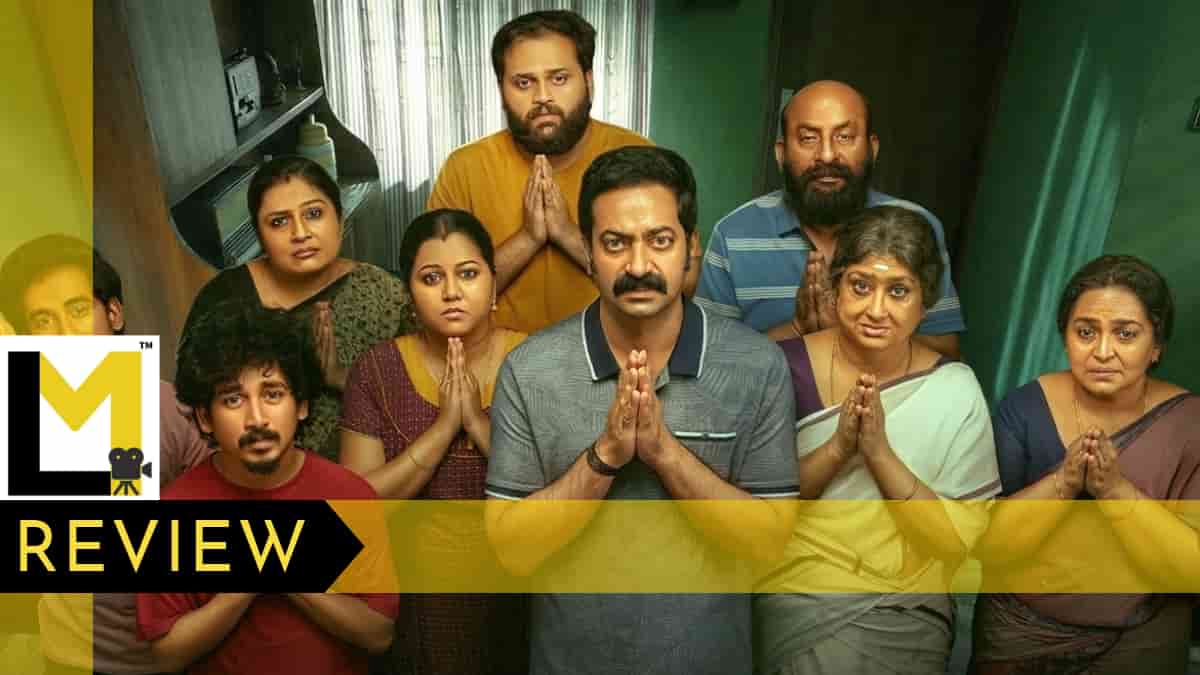
For people who closely monitor developments around the release of a new movie, the kind of reviews that preceded the release of the film Mohiniyattam, also known as Bharathanatyam 2, from filmmakers like Tharun Moorthy and Midhun Manuel Thomas, added a sense of skepticism, as it felt like an attempt to save the movie. Well, they weren’t exaggerating. Mohiniyattam, the sequel of Bharathanatyam, is a movie that delivers on all its promises. There is a smooth genre transition, and they have amplified the eventfulness in the script, making it a thoroughly enjoyable dark humor film, significantly better than the first part.
Post the events we saw in Bharathanatyam, this time the story shifts to Sreekandapuram as Sasidharan and family decide to help Rukmini Amma have a home of her own. Unfortunately, that short trip got extended when an old friend of Bharathan Nair, Govinda Raja, paid a visit and revealed certain things about Bharathan Nair. How those revelations change everything for the family is what we see in Mohiniyattam.
Bharathanatyam was a pretty simplistic film that used the Mookambika trope we have seen in multiple films humorously. The core element of that movie was hiding a truth about Bharathan Nair from everyone else. When it comes to Mohiniyattam, Krishnadas Murali and his co-writer Vishnu R Pradeep are retaining that hiding aspect, and they are developing that into a scenario that is darker, comical, and full of events. The good thing about the writing is that they are not trying to repeat the first movie by simply changing the characters and retaining the conflict. Here, the conflicts are different, and even the usual hero versus villain kind of setup is getting a tweak towards the last quarter.
What makes the movie interesting is indeed the writing. The movie is not taking much time to gather momentum. If you look at Bharathanatyam, it takes ample time to reach that first genuinely comical moment of Bharathan Nair dropping the truth bomb. Here, almost in the first 10 minutes, we are getting teased about some foul play, and since there is no spoonfeeding happening, we are curious to know how those events are going to get connected with Bharathan Nair and his family. Like how they have shown in the trailer, there is that slightly spoofy version of Drishyam happening in the film. But Krishnadas Murali is giving the movie an additional layer of religious satire using the history of Bharathan Nair.
The second half of the movie is the area where the movie scores enormously through humor. The way it uses the “Subash” character was hilarious, especially the bus stand 7aam Arivu reference. While the first part focused more on the emotional aspects of the story, with Sasidharan Nair and family eventually accepting the second family, the sequel totally avoids that aspect. Even some of the seemingly cheesy moments in the beginning are actually planted for laughter at a later stage. The way the screenplay reshapes the team structure in the story is also extremely funny. It was good to see multiple elements in the first part smoothly getting placed here, like the spirit dialogue, the way one Subhash talks about the greater potential of the other Subhash, the Velichapadu equivalent search, etc., which were all quality callbacks.
If you look at the casting and scope for performance, it feels like an even field this time. In the first part, there were a few characters who had prominence in screentime and story. Nandu Poduval and Swathi Das Prabhu were almost background artists in the first movie, and the movie gave priority to the dynamics between the twins and Rumini Amma. However, this time they are all acting like a team, and hence the importance is evenly distributed. Saiju Kurup gets to do his character in a tone that is more towards his safe zone. Kala Ranjini, this time, gets a better space to showcase her funny shade. Sreeja Ravi, Divya M Nair, and Sruthy Suresh were fine in their respective roles. Abhiram Radhakrishnan reprises his role as Subhash, and it was really fun.
Suraj Venjaramood is the first major addition to the character pool, and he was absolutely brilliant. The antagonistic shade of that character is not getting lost when the character slips into humor, and that was a remarkable display of balancing. Baby Jean plays this character named Subash, and he performed the hilarious transition of that character perfectly. Jagadish’s character has very minimal screentime, but that part utilizes the two zones of Jagadish’s performance very effectively. Vinay Forrt, as the police officer, gets to play a character who looks like what if Vimal Sir from Premam joined the police, as the goofiness was pretty similar. Nisthar Sait, Santhosh K Nayar, etc., were also fine in their respective roles.
Since the movie has switched its genre to black comedy, one can see changes in the lensing and production design of the film. There are these recurring wide-angle shots that cover the whole family in a tiny space, and even the interior of the new house has a peculiar feel, different from Bharathan Nair’s house. And it all adds to the eccentric tone of the new film. Mohiniyattam successfully surpasses Bharathanatyam by having multiple layers of humor. From the number of events happening within a span of time to the number of laugh-out-loud moments being offered to the audience through dialogue humor, and satire, everything has increased in this sequel. On the whole, Mohiniyattam is an engaging dark comedy with zero dull moments.
