
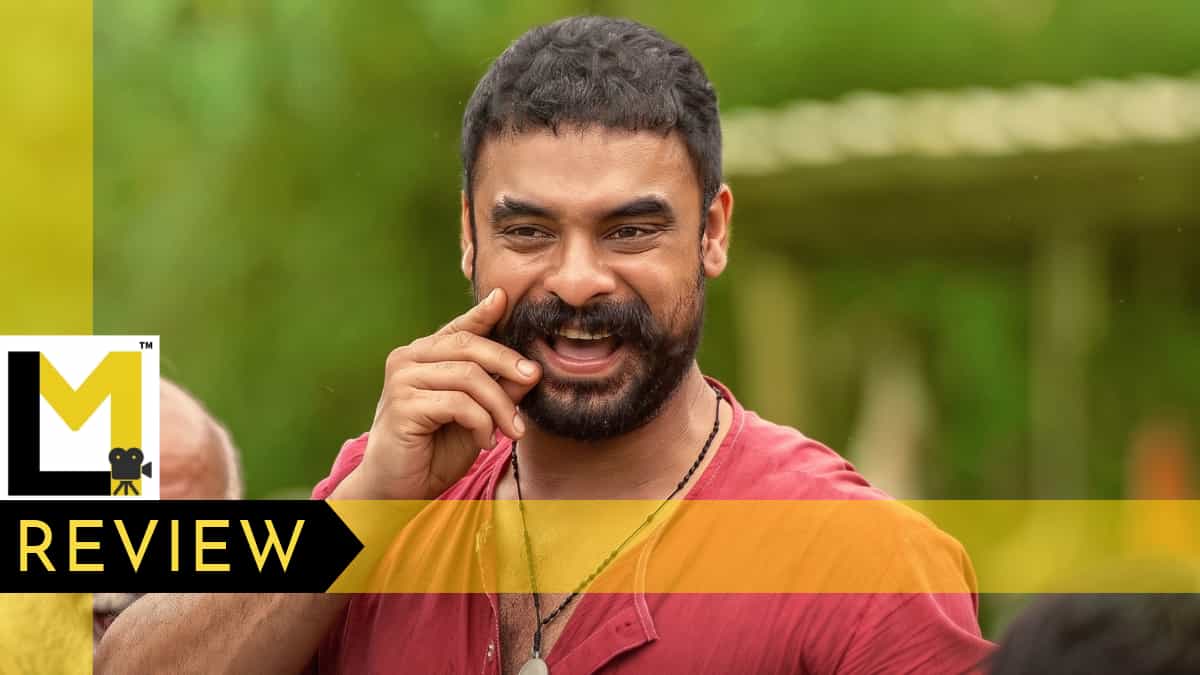
If you look at movies made by Dijo Jose Antony, there are these common elements of cinematic heroic rhetoric, old school villains, and even the idea of showing the unity of people. In movies like Jana Gana Mana and Queen, one can clearly see him and his frequent collaborator Sharis Mohammed trying to please the gallery with dialogues and situations that are a bit too outlandish. I wasn’t a fan of such theatrics, and perhaps the success of those movies has made Dijo believe that it will always work. Pallichattambi, his latest movie, in which he collaborates with a different writer for the first time, may have a different backdrop compared to Dijo’s other films. But the treatment he has given this movie would remind you of the packaged loudness of his other films. And what you eventually get is a predictable, familiar drama that tries to incorporate many of the new masala traits we have been seeing in the recent pan-Indian films.
The story is set in 1958 against the backdrop of a village named Kaaniyar. The Church in Kaaniyar was against the policies of the Communist Government, and the rise in Communist workers in the village led to a scenario where the church had to find a strong Christopher – a protector. What all happens after the arrival of the new Christopher, aka Pallichattambi, is what we see in this film.
In Jana Gana Mana, there is a sequence featuring Dijo Jose Antony as a college professor who urges the students to go and participate in a strike against government policies. If you are someone who has enjoyed the unsubtle staging of that scene, which I thought was a desperate attempt by the makers to say, “hey, look, we are also political”, I would say you might feel that Pallichattambi is a movie with good intentions. I also wouldn’t say this film has bad intentions. In fact, it was good to see a movie shedding light on the Liberation Struggle, an event most adults in the current generation have not really bothered to know more about. However, the problem is the format in which the story is being narrated.
Writer Suresh Babu, who has previously written movies like Shikhar, Kanal, Oruthee, etc., has a screenplay where the characters are relevant to the story. There is a motivating factor that connects characters to the plot. But the presentation of that feels outdated, especially due to the obvious exposition happening through dialogues. It feels like Dijo is also confused about how much commercial he should go with the treatment. The first half invests a little too much in romance and other things, so that when that “Ayyo Acha Pokalle” equivalent moment happens between Chattambi and his disciples, you just won’t feel anything. Towards the end, Dijo wants the movie to have that Avengers Assemble vibe. But the writing has forgotten to establish the Avengers by that time, and the last-minute buildup to all of them through poetic dialogues fell flat.
The movie was denied a censor certificate initially due to the election. And the content here is pro-left. I am not saying that a cinema having a political inclination is a wrong thing. But it shouldn’t feel like buttering. Here, the script tries to please everyone, and it is done in the most obvious way. To balance things out and not agitate any Congress sympathizers, their late leader from Puthuppally gets a mass scene. The problem with Dijo Jose Antony’s direction is that he thinks the way he has mounted such scenes through those dialogues is still fresh. And that problem is consistently there in this film. The music from Jakes Bejoy is really good. Kaattuchembakam is already trending, and I loved the track he used in the climax fight sequence. The design of the fight sequences is unable to cover the glitches, and in many frames, that is very evident. I am not really sure, but looking at the kind of distortions in the visuals, I think they have used AI extensively to create motion-freezing in that climax fight.
The character of Christopher feels like a collage of multiple characters Tovino Thomas has already done. Tovino looks convincing in terms of the physicality of the character and in portions where he is in charge. There are areas, especially in the first half, where this beefed-up guy is supposed to do comedy, and the treatment wasn’t really favoring Tovino in those portions. Kayadu Lohar as KPAC Rebecca was okay in her small part, which had a significant role in the hero’s journey. The dubbing was a bit clumsy, but the primary task was to look charming, and I thought Kayadu managed to do that convincingly. Telugu actor Shatru played the part of the antagonist. While he did look intimidating, I didn’t understand the logic of making him say tough Malayalam. Because, at times, it made that character a bit comical. The elaborate cast of the movie has names like TG Ravi, Vijayaraghavan, Siddique, Baburaj, etc., and almost all of them felt like familiar characters from other films.
The cameo, which is no longer a secret, is positioned interestingly in this film. Unfortunately, it almost felt like a final attempt to salvage this movie that wasn’t able to create an elevation in its emotional graph. The story of Pallichattambi had a nice way of integrating characters into the plot with a purpose. However, the movie prefers tried and tested theatrics, and that leads to a scenario where the important chapters get less emphasis. On the whole, Dijo Jose Antony’s movie struggles to justify the scale at which it is mounted.
