
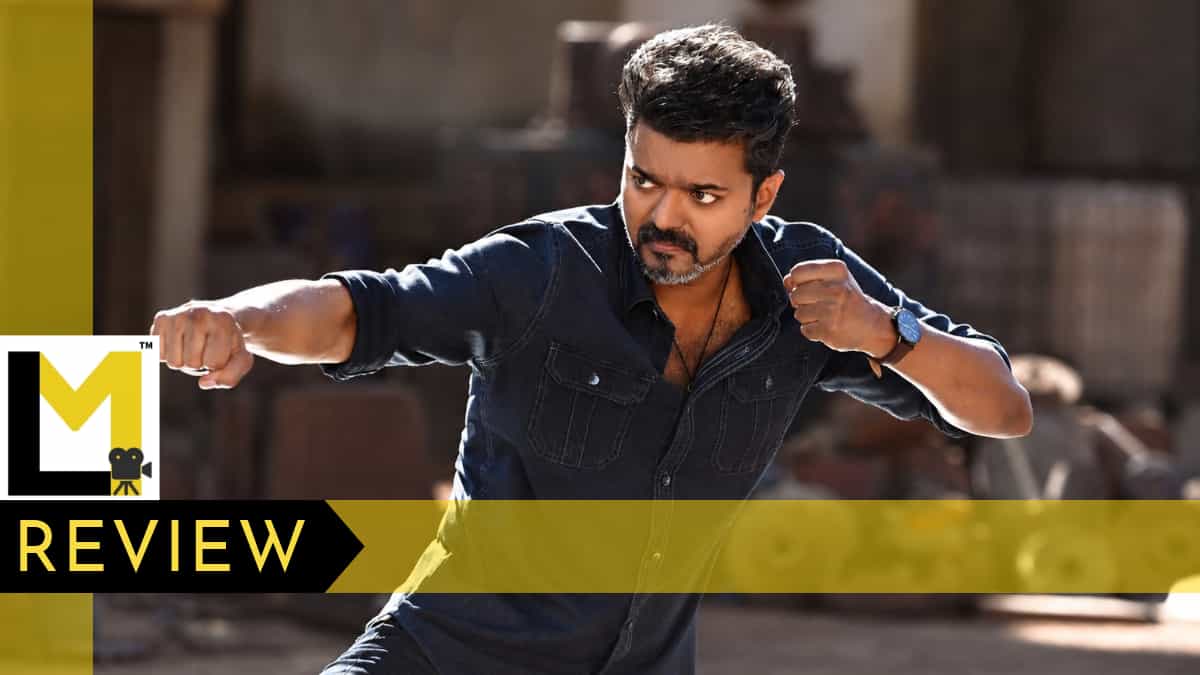


It’s a no-brainer for anyone with a brain that Vijay’s final film, Jana Nayagan, which was embroiled in a lot of controversies as it struggled to get a censor certificate, was a highly politically motivated movie that was part of his election campaign. An official remake of Balakrishna starrer Bhagavanth Kesari, Jana Nayagan feels like an over-the-top Vijay movie in the first half, and the second half is an over-the-top election manifesto where Vijay is basically lecturing and giving assurances on what he would do. If you are okay with seeing that on the big screen, this one will be perfect for you. If you are looking for cinema, or even a fitting tribute to the actor, a reedited version is required.
Thalapathy Vetri Kondan is in jail, and he is a very righteous man who was obviously imprisoned for wrong reasons. In jail, he forms a warm equation with the jailer and his daughter Viji. Viji has a certain phobia that triggers panic attacks in her, and what we see in the movie is Thalapathy being with her like a father in the absence of her father to help her overcome this situation.
One of the things H Vinoth mentioned in an interview about remaking a Balayya movie was the fact that almost all of NBK’s movies are set in a different universe where he can do all the physics-defying things. Even though Vijay is a star who does all the over-the-top stuff in his movies, the level set by Balakrishna is too high and too risky. Thankfully, H Vinoth has applied logic on a script level to reimagine a lot of the NBK universe stuff to match the Vijay universe sensibility. And frankly, this fixing-the-flaws remaking style is making the movie a lot more watchable. Multiple songs and multiple fight sequences are setting it up as that enjoyable commercial entertainer.
The problem with the movie starts in the second half when the script says tata bye bye to Kesari and pushes the story to a different space. It is almost like H Vinoth rewrote the first half and Vijay wrote the second half. Some of the elements like Viji’s fear, the need for women to be independent, and the hero educating kids about good touch and bad touch were there in the original. But here, with the hero being addressed as Thalapathy every single time, and with the problems he solves and the advice he gives increasing, it feels like a dictatorial rant about democracy. There is one scene where Thalapathy overhears Viji calling him Thalapathy, Annan, Chithappa, and eventually Appa. When the character sheds tears hearing that, I felt the urge to tell him “Anna Konjam Keele Irangu.”
The dialogue writing in the scenes where the hero threatens his opponents is really good. But the moments that show us others, especially the members on the opposite side, adding build-up to the hero felt funny. It was like some of those B Unnikrishnan movies. As I said, the second half is designed keeping in mind which political opponents to take on. From DMK’s dynastic politics to BJP’s communal politics, the film projects Thalapathy as the saviour of Tamil Nadu and, to an extent, India from all these bad trends. The villain of this movie has an entirely different backstory from the original, and thus the movie explores new elements like RC warfare and robots. While it all looks grand on paper, on screen, it just felt like chaos. Sathyan Suryan gives the visual grandeur to the movie through his frames. The pacing of the movie is impressive. Anirudh packs the album with peppy songs and slower, sentimental ones.
In his last film, Vijay gets to do a role that pretty much showcases his emotional range as an actor, and obviously the one that works the most is the delivery of swagger. When it comes to portraying the sentimental bits, he is still weak, but since Balayya has set the bar so low, it will feel like a much better performance for those who have seen the Telugu version. The most effort Pooja Hegde may have taken would be for the Kacheri song. I really liked Mamitha Baiju’s performance in the movie. In the earlier parts, her panic bits felt much more real, and in the climax showdown, she was so flexible that the combo of her and Vijay carried equal levels of style. Looking at the way she cracked the superhero landing pose in the fight sequence, I feel somebody should imagine an action-oriented story for her. Prakash Raj, in his typical style, performed the role of local antagonist neatly. Bobby Deol is that typical imported villain whose only job is to be grumpy in all situations.
This is like a perfect movie for TVK supporters to energise if their camp is feeling a bit low. Because the film literally ends with Vijay coming out of a polling booth and asking the audience for change. If you are that hardcore Vijay fan, I am pretty sure you are not watching any reviews to know whether to watch the movie or not. Because for those people, this is not a movie. It is designed as a collection of all his celebrated on-screen and off-screen moments. And even though I was not a fan of this movie, I must say that in my career as a film critic, there were a lot of memories associated with the release of his movies. Be it the craze to get tickets, or the controversies around releases like Thalaiva and Puli, there is a good possibility that the culture of 4 AM, 5 AM FDFS shows might end with his decision to call it a day. If you can act like a TVK supporter for three hours, then there is enough in this movie for you to scream. I actually enjoyed some bits of this movie by looking at the joy on the faces of those who were able to switch on the TVK mode.