
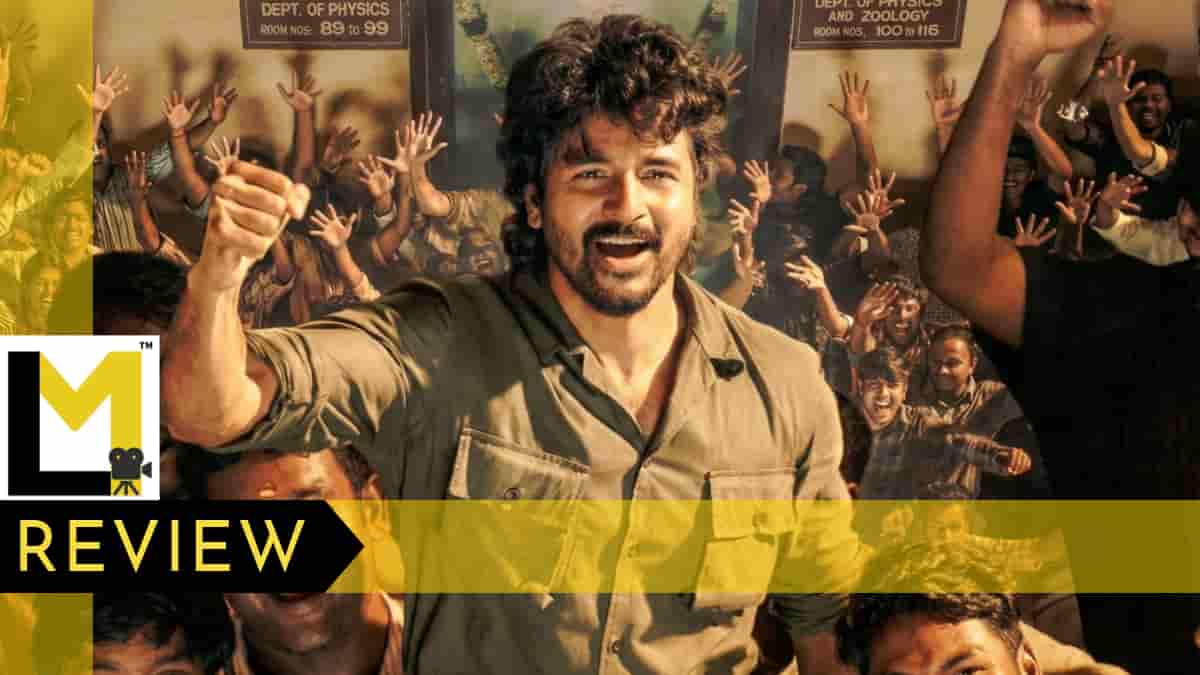
With the current central government trying to impose Hindi as the official language of the country, in the last few years, we have been hearing various verbal spats between those who endorse that idea and those who are not willing to accept it. Historically, the southern states have always resisted this move, and in the mid-1960s, there were student protests that happened in Tamil Nadu, along with many other states, against the move of the then government to impose Hindi. Sudha Kongara’s new movie, Parasakthi, is a fictional story based on the real protests that took place during those times. While the fact that 60 years later, history is repeating itself is giving a lot of relevance to this film, the cinematic packaging of the movie is heavily compromised, and the crowdedness of the screenplay does not allow you to root for the emotions.
In the early 60’s, when there was an attempt to impose Hindi, a student movement happened in Tamil Nadu, and it was led by Chezhiyan. Students from various states were part of that movement. Even though it made the government pushback its plans for a while, some of the other things that happened along with that affected the progress of this movement. What we see here is how a revival of the same protest happened when the government tried to impose Hindi again.
The cinematic structure of Parasakthi is a classic template. There is an emotional inner conflict that is creating hesitation in our hero’s mind. And we know that his overcoming of it would be the anticipated cinematic moment of this movie. But the problem is the packaging. Sudha Kongara has this added responsibility of making this movie a Pongal release that would appeal to even the B and C center audience who are less concerned about nuances. So, in between these major plot points, Sudha Kongara is stuffing moments of brotherhood, romance, and other struggles in the most obvious way. That decision makes the movie look crowded with stuff that isn’t really adding to the plot.
Much like how Mani Ratnam made Iruvar, this movie is Sudha Kongara’s attempt to crack something like that, as the foundation of the movie is based on true events and characters. While something like Iruvar could fully invest in characters and story, Sudha Kongara’s storytelling is confused between being subtle and loud. Towards the end of the movie, when the hero is trying to pull off a signature campaign in the ’60s, there are these moments like characters chanting, “Malayali, Malayali, Malayali” or a Bengali singing “Ekla Cholo Re”. I mean, this loud way of showing the unity in diversity of the rest of the Indians just wasn’t something I was anticipating in a Sudha Kongara movie. The frames of Ravi K Chandran are adding that retro charm without being excessively glossy. Sudha Kongara has tried to keep the locations as real as possible. But the problem is that whenever the film shifts to a green screen scene, the difference is really evident. The big scale moments in the movie are getting these messy cuts, which take away the wow factor from the scene.
The story is happening over a span of 6 or 7 years in this movie, and that widens the canvas in a significant way. There are no unnecessary subplots. Every emotional detour in the film, or even the romance, has a purpose. But the thing is, whenever a character is introduced, you can immediately guess the purpose and fate of that character, and the story will precisely go in that direction. The drama they are trying to build by making this half-Tamilian guy the antagonist is very obvious. Since the language politics may not be a favorite topic for a lot of apolitical people out there, this movie’s commercial stance, in a way, gives such people this capsule information on why a move to impose a language on others should be resisted and why it is not an equal playing ground.
Sivakarthikeyan as Chezhiyan is getting into that leader aura after resisting such a post multiple times. So there is a space in the movie where he is this caring brother and that jovial boy next door. And in those parts, his acting works really well. But when it comes to these emotionally charged lines that are supposed to move the audience, I found the performance underwhelming. Ravi Mohan as Thiru is an interesting casting choice, and seeing him as this remorseless officer in certain scenes is a fresh sight. Maybe because of the lack of impact of the opening scene, his anger towards the Tamil lacked depth. Sreeleela is unable to create an impression. She has a role to play in the whole movement, and there is also a personal arc to that character. But the performance is still stuck in the way she performed anxiety in Bhagavanth Kesari. Atharvaa had that charm in being this disobedient rebel. It is a character you can very easily predict for his hot-headed nature. But Atharvaa manages to add life to that behaviour. There are many others in the movie who have done character roles to guest appearances. However, I must say, with just 15 seconds of screentime, Basil Joseph was able to create a spike in the graph of this movie.
In many ways, Parasakthi is the Rang De Basanti equivalent to a Tamil audience. While Rang De Basanti’s craft focused on evoking an emotion, Parasakthi is trying to build a script using sensible arguments in this language debate. Hence, the intentions of Parasakthi are noble. But in terms of the magic of filmmaking, you are not leaving the theater with the high of having seen something that had an impact on you. If you are someone who is absolutely ignorant about the whole language debate, including the “Hindi Theriyathu Poda”, then this movie might well work as political GK 101 for you.
