
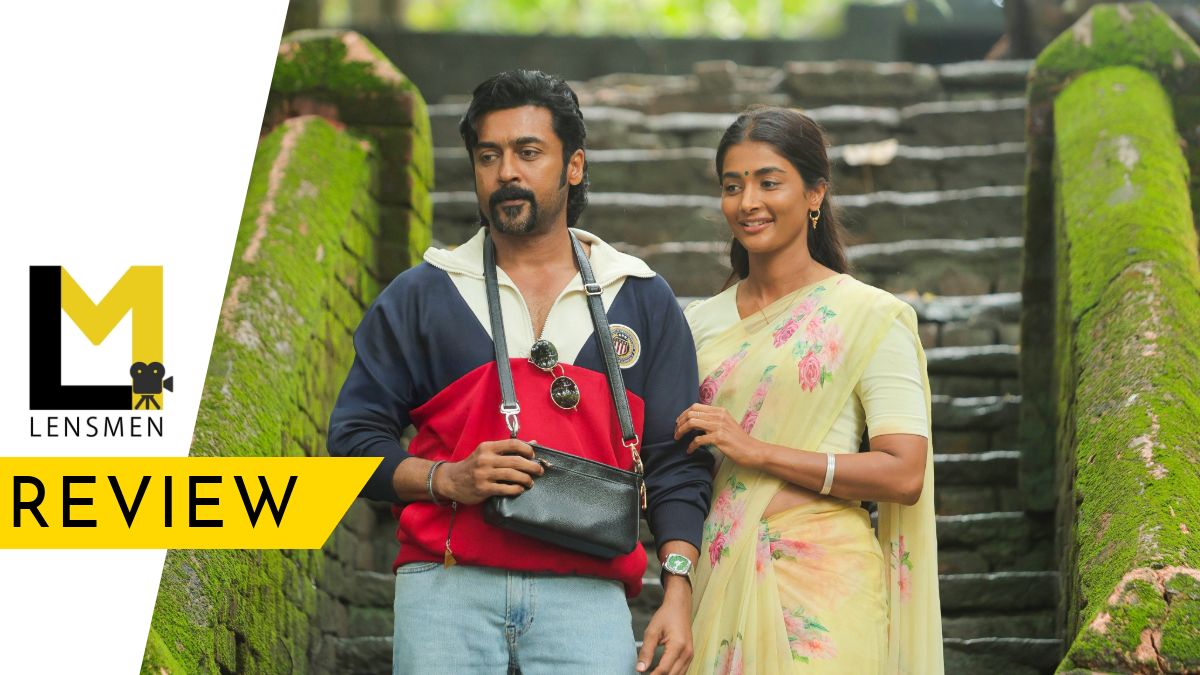
Revolt is something we have seen in the last Karthik Subbaraj directorial, Jigarthanda DoubleX. The climax of that movie sort of captured the essence of the rebellion with those spectacular visuals. His latest film, Retro, has a thematic similarity in terms of the story’s structure with the second Jigarthanda film. But Karthik is trying to handle too many elements here, ranging from mythological metaphors to power politics. While they all are worth a certain level of appreciation in isolation, the ultimate blend of all this, which is the entire movie, just can’t hold your attention consistently.
SPOILERS AHEAD! The film is primarily set in the early ’90s, and our main man, Paarivel Kannan, aka Paari, now plans to settle down in life, leaving all the gangster stuff he used to do for his father. But his attempts to have a peaceful life with his lover Rukmini, aka Rukku, don’t go as smoothly as he planned because of the consistent interference of his past life. Paari’s efforts to sort out this situation and what eventually happens in that journey is what we see in Retro.
At its core, the movie is a political film, and if you look at the idea of the movie, which is kind of revealed in the final moments of it, it has a preachy tone. But as a filmmaker, Karthik Subbaraj is trying to package that preachy idea into the format of a genre film that has cinematic elements. Like a Quentin Tarantino movie, Karthik splits his movie into chapters, and even the color palette of the movie in each chapter has a distinctiveness. In a way, these are all distractions to make us not think about the outdated tropes they have used in the movie. But because of the lack of impact, these elements in the story sort of stick out as flaws.
The screenplay of Retro has plans to make the climax of the film a culmination of multiple tussles of the hero. While the political purpose of the whole thing makes sense, it just doesn’t manage to create a cinematic high. It is like a mixed bag of themes, where some of them are subtle, while most of them are a bit too on your face. Karthik Subbaraj has a way of staging sequences in a more raw way, and that sort of diminishes the generic feel of the scenes in many areas. The chapters we see in the film and the quirks we see in the story like the absence of laughter, Buddhist idealogy, Lord Krishna metaphor, etc., have a purpose in giving shape to the story. But felt like a bit more finetuning was necessary. Santhosh Narayanan’s songs are unique. And the kind of instruments he used for the background score of this movie is really enhancing the identity of those scenes.
The character limitation in the first half of the movie puts Suriya outside his comfort zone. But in the second half, it really gives him the space to be the performer with swagger and stuff. Pooja Hegde as Rukmini is believable and has a warm chemistry with Suriya when her character is in a calmer space. But in some sequences where the character’s vulnerability makes her perform the role in a louder pitch, she sort of loses the grip. Joju George was fine as Paari’s father. I really liked Jayaram’s performance as the laughter doctor and it was nice to see them cast a Malayali to play a Malayali character. Vidhyashankar Neelamegham, aka Vidhu, has played the role of this villain character, King. At times the Mad Max energy of that character and that entire track was a bit odd. Sujith Shankar, Nassar, Prakash Raj, etc., are the other major names in the elaborate cast of this film.
Multiple tracks, metaphorical themes, chapter-wise narration, and elements of violence, love, and politics, all these are making Retro a very compelling idea on paper. And it also makes you curious how a filmmaker would be able to package all these tonally contrasting ideas into one single movie. While the lengthy single shot in the wedding sequence and other sequences that have a visually exciting presentation keep us engaged in the film, Retro is missing out on cracking that impactful end punch.
