
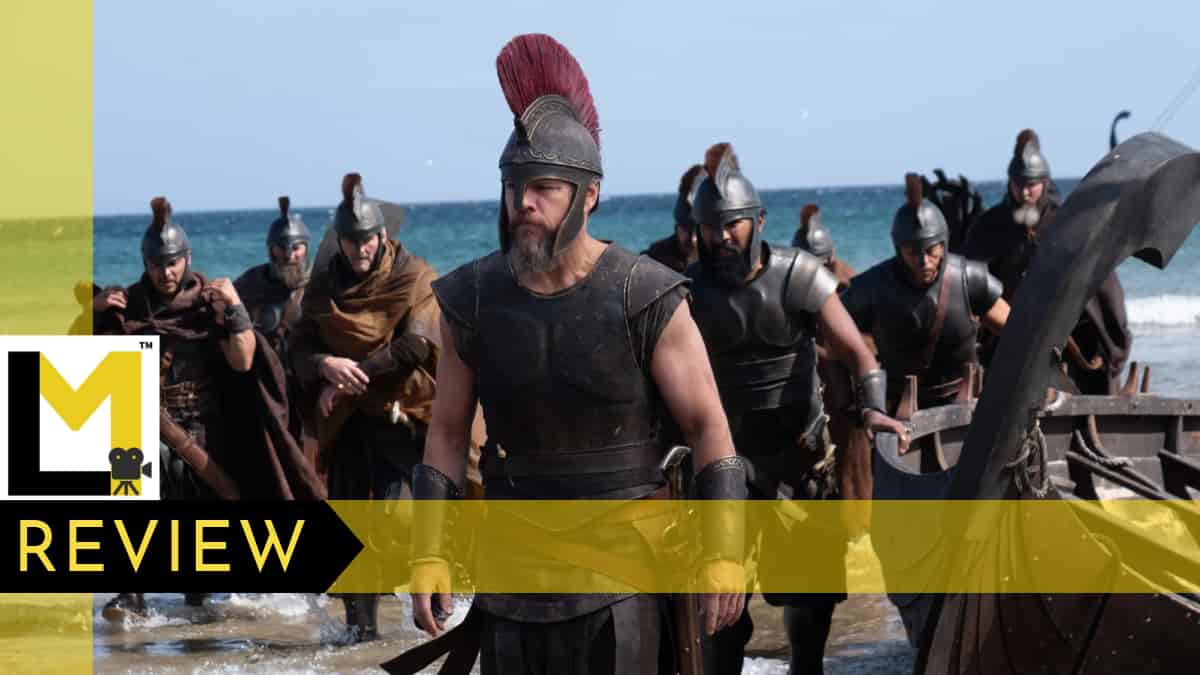


At its core, the new Christopher Nolan movie, The Odyssey, explores the regret of a man. And it is interesting that through his last two films, Nolan has moved away from the label of being someone who takes up complex projects to becoming a filmmaker who makes grand-scale movies that deal with one individual’s guilt. Just like how Oppenheimer was more about the character and less about the spectacle one would associate with that kind of a story, The Odyssey also gets a treatment where that story is narrated from the point of view of human characters. With the crisscross narrative ultimately helping us in feeling the eventful journey of King Odysseus, The Odyssey is a spectacular cinematic achievement.
So, the Odyssey, based on which this movie is written, is a 3000 year old 12,000 + line epic poem in Greek literature. After the ten-year-long Trojan War, Odysseus plans to return to his home, Ithaca, and he chooses a different path for his crew. Aimed for a faster return, the plans don’t go the way he intended, as that return journey met with some really horrifying encounters. In the meantime, in Ithaca, without a king, Odysseus’ wife Penelope and son Telemachus were finding it really difficult as suitors were constantly trying to marry Penelope and become the king. What we see here is the eventful journey of Odysseus to reach his home and the resistance shown by Penelope and Telemachus.
In one of the interviews, Matt Damon had said that after a scene that involves destruction and chaos, cinematographer Hoyte van Hoytema casually told him that this would all be a flashback cut. That anecdote sort of tells you how Mr. Nolan applies scale to this subject. Many filmmakers would have captured the Trojan War in this movie in a way that shows the scale of it, showing off the level of destruction it generated. But Nolan sticks to Odysseus, just like how he explored Oppenheimer. The decision to keep it real by shooting it on real locations with minimal CGI and maximum practical effects really helps the movie in making us empathize with Odysseus when he eventually realizes his mistakes.
Christopher Nolan uses his signature non-linear structure here to get us into the story world immediately. He knows that everybody out there is familiar with the story, and a linear narration will be a flat one that will never create a sense of intrigue. Up until the Cyclops chapter, even though it is set in that mythical world of Greek Gods, things are pretty grounded. While the Cyclops chapter is pretty much an introduction to the fantasy element of this story, the real shocker is the Circe episode, which was visualized masterfully. The real emotional trigger in the movie happens in Hades, and with great staging, Nolan manages to tell us that this movie is more about the mental space of Odysseus.
Nolan is known for his fondness for practical effects. Since the movie is talking about a man’s regret and guilt, the visuals are largely from POVs close to him. There are only very minimal shots that have this establishing shot kind of feel. If you try to get an idea of the events that happen in Homer’s Odyssey, it is a very fantastical idea with monsters of various natures. But rather than opting for a bird’s-eye view of the whole drama, The Odyssey places us among Odysseus’s crew. Hence, in those panicked visuals, you don’t really need to see a full-sized Cyclops or Scylla to understand the horror which Odysseus’s men experienced. Despite the final act being a predictable one, with some interesting payoffs, the action block also lands effectively.
Matt Damon plays the role of Odysseus in the movie, and even though he is in a warrior costume, the film is more about the emotional space of that character. There is a sense of lack of remorse in the earlier parts of the movie, which gradually changes, and he performed that transformation of the character impressively. Anne Hathaway as Penelope perhaps gets the most dramatic character in the movie, as the pressure around that character was enormous. It was a very solid performance that conveyed her authority and vulnerability to the audience. Tom Holland as Telemachus has that element of naivety in his face, and that really makes him a good choice for the role, and he was able to pull it off in a convincing manner. Robert Pattinson as Antinous performed the evil intentions of the character in a believable manner. Zendaya as Athena and Charlize Theron as Calypso have very minimal screen time, but were pretty effective as those characters. Samantha Morton as Circe and John Leguizamo as Eumaeus were also pretty memorable.
The writing is doing certain structural experiments, and that is allowing Nolan to push the all-important war sequence to the final moments of the movie. Hoyte van Hoytema’s cinematography offers that up-close experience, as the movie intends to show us the deeply personal state of each character. The production design is immaculate, and I would really love to see the behind-the-scenes visuals of some of the sequences that had so many people in the frame. I don’t know whether it was because of the under-3-minute rolling time of IMAX cameras, but in the very first conversation between Odysseus and Penelope, one could see certain jump cuts. Ludwig Göransson is not pumping in too many musical elements into the movie, and in certain parts, it was like those build-up phases in Dark Knight with that thudding sound with high bass building the intrigue.
The emphasis is not on the over-the-top elements, and many tweaks are there in the movie to make the characters a lot more humane and the story a tale of survival. For instance, Nolan is not showing the ego of Odysseus by making him reveal his name to the Cyclops to piss off Poseidon. The whole windbag chapter is omitted from the movie; maybe it was too fantastical to have a slightly grounded version. By exploring the iconic Trojan Horse as a symbol of guilt and violation of war laws, Christopher Nolan creates a movie that goes deeper into the idea of conquest beyond its peripheral glory. From a cinephile point of view, it was more like the joy of seeing a great interpretation of a source material that somewhere felt unfilmable on a plot level.
