
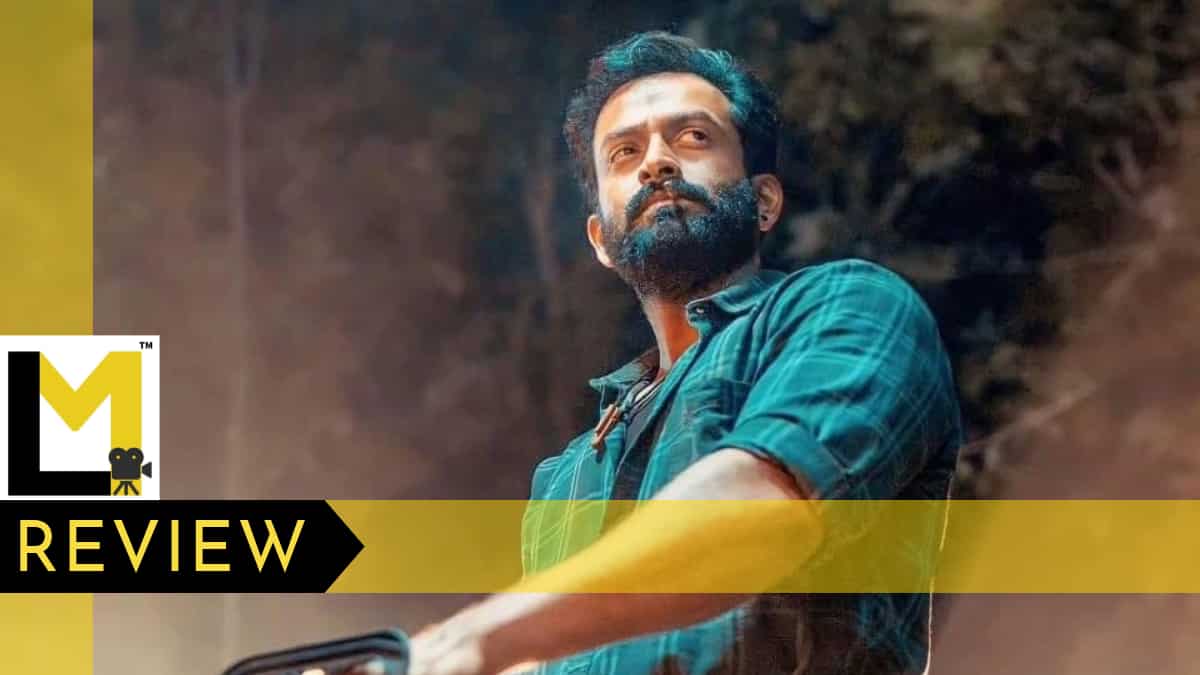


Towards the end of Vilaayath Buddha, there is a conversation between the two main characters, Mohanan and Bhaskaran, about how each had their own valid reasons for being adamant about the sandalwood tree in Bhaskaran’s house. The performance of Shammi Thilakan in the scene is so good that it almost felt like the movie did an injustice to his caliber by making a script that ignored the emotional struggle of that character. With every buildup falling flat and the focus going after the comical or massy elements, Vilaayath Buddha fails to generate a connection between the audience and the characters.
So the story is set against the backdrop of Marayoor, and our main man, Double Mohanan, is a chotta Pushpa who smuggles the sandalwood that is monitored by the forest department. There is one more character in the story, Bhaskaran Mash, who was a teacher and then became the Panchayat President. A humiliating chapter in his life made him take a sabbatical from his political career. Both Mohanan and Bhaskaran Mash have a certain plan, and what we see here is how a sandalwood tree creates a rift between them in achieving their goals.
I have not read the source material book by GR Indugopan, so this review won’t be a comparison. Indugopan, along with Rajesh Pinnadan, has written the screenplay of this Jayan Nambiar film. Since the male ego becomes an igniting factor in the movie, you would easily understand why movie people were excited about creating a film out of the book. The character designs and character arcs have that cinematic quality one would love to see. But somewhere, I felt the writing made the whole thing look very episodic and obvious. First, we are seeing what happened with Bhaskaran. Then we are seeing why Mohanan is involved in all these activities. And then the very obvious conflict arises, and the movie’s tone changes in the predictable direction.
The issue is that the movie sort of indulges too much in these chapters. You need to feel a sense of empathy towards Bhaskaran and Mohanan for what they had to go through. But the overtly comical nature of the Bhaskaran track and the excessively mass masala tone of the Mohanan plot distract us from this element. In a movie like Ayyappanum Koshiyum, where a similar conflict was occurring, we could see a clash happening between equally flawed people. When it comes to Vilaayath Buddha, the characterizations on a writing level are such that you have been asked to feel equal empathy towards a hero character and a comical villain (almost a Pillechan from Meesha Madhavan). The screenplay fails to establish the humiliation of Bhaskaran and the determination of Mohanan effectively.
The movie had to go through many schedule breaks because of various reasons, and one can see Prithviraj’s looks changing from one scene to another. When it comes to the performance, there are patches in the movie where the typical over-dramatized dialogue delivery of Prithviraj happens, and it was perhaps one of those areas where I missed Sachy. Because he churned out one of Prithvi’s best performances in Ayyappanum Koshiyum. Shammi Thilakan is undeniably the best performer. He performs according to the pitch of the writing. Since the writing itself does not depict the emotions of that character properly, despite Shammi Thilakan giving his honest best, you wouldn’t really feel bad for the character. The hospital scene performance was extremely good, but the writing of the earlier portions of the movie wasn’t doing justice to that performance. Priyamvada Krishnan’s bold and demanding Chaithanya is also not getting enough space, considering how her adamance has a key role in the story. Teejey Arunasalam, Anu Mohan, Dhruvan, Pramod Veliyanadu, and many more are in the star cast.
Vilaayath Buddha, in totality, feels like a movie that lost its focus. There is a part in the film where we see Mohanan’s ultimate goal, and there is a mountain-top sequence with tacky visual effects that shows you why he is doing all these things. The movie is so lost in the initial buildups and rhetoric that by the time it reaches these areas, you have lost interest in the drama.
