
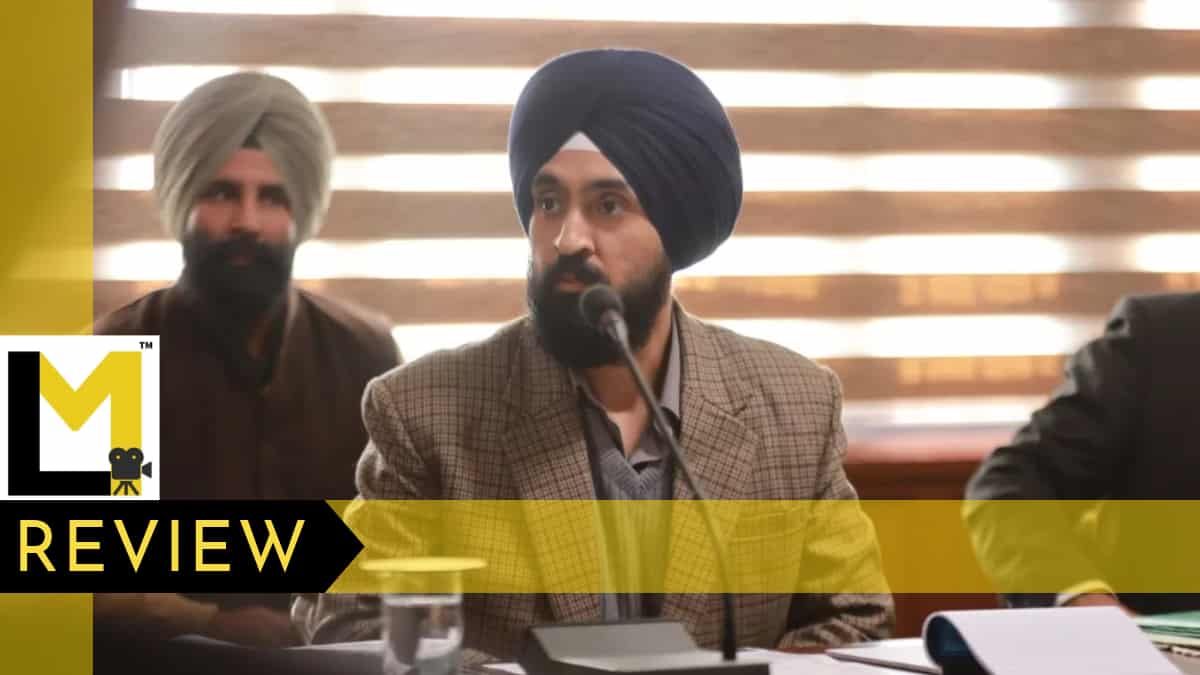


Before jumping into the review, for those who are unaware of the history of this new movie, Satluj’s, previously titled Punjab ’95, censor board challenges, this movie was in a tussle with the CBFC of India from December 2022. The movie talks about the extrajudicial killings carried out by the Punjab Police during the Punjab Insurgency. Since it spoke out against the system, the censor board demanded almost 120 cuts at one point. The makers tried to release the movie outside India, but that move was blocked. They tried to give the movie a premiere at the 2023 Toronto International Film Festival, but diplomatic pressure blocked it. Finally, after so many hurdles, the movie was released as a direct OTT release on ZEE5, and by the time I finished watching it yesterday (July 5th), I got this update that the authorities have asked ZEE5 to take the movie down.
When you finish watching Satluj, a kind of numbness seeps into you because what you just witnessed was based on reality. It is not a movie that immediately pulls you into that traumatic space. From a documenting point of view, the film shifts to a cinematic perspective towards the end, and on a craft level, that’s where director Honey Trehan makes the movie deeply impactful. When you have a subject like this, the general tendency is to narrate it through the central character. However, Punjab 95 aka Satluj breaks that style, and that creative decision makes it a thoroughly gripping film.
So this is a true story, and if you have no idea who Jaswant Singh Khalra is, even the basic premise of the movie can feel like a spoiler. So during the insurgency times in Punjab, there were a lot of missing persons cases, and at one point, Jaswant Singh also went to the police station to enquire about his late friend’s mother. The reaction from the police made Khalra do an investigation in his own limited capacity, and he realized a genocidal level, state-supported crime spree was happening in the state. His fight to bring that out to the public spotlight and what all happens when he did that is what we see in this movie.
The first half of this Honey Trehan movie, on a script level, is somewhat basic. By basic, I mean it largely documents the events that led the main man, Jaswant Singh Khalra, to do this activism for his people. So, in the 2 hours and 43 minutes movie, almost 1 hour and 15 minutes is the first half, and that is dedicated to showing us the key events in Jaswant Singh Khalra’s life. The second half is where we see the people in power coming under scrutiny, as there was foreign pressure to deliver justice to Jaswant Singh Khalra. The design of the second half, which comes across as a cat-and-mouse game between CBI and Punjab police, is smart and cinematic. It is not taking too many creative liberties. In fact, it was interesting to see them build a thriller-like narrative using the limitations CBI faced in this investigation. The transformation of the CBI officer played by Arjun Rampal almost mirrors our emotional transformation while watching the movie.
Diljit Dosanjh plays the central character Jaswant Singh Khalra, and the actor’s likable charm comes in handy in these earlier portions where we see Jaswant Singh realising what is happening around him. In the second half of the movie, Diljit’s presence is very minimal. But there are two instances in the movie where he is shown again, and I would say those portions have the career-best performance from Diljit, especially the conversation he has with the character Kuljit. Suvinder Vicky as SSP Sugga was brilliant in playing that ruthless police officer with conviction. Even though the screen time was a bit scattered, Geetika Vidya Ohlyan, as the better half of Jaswant Singh, did a great job. Arjun Rampal as the CBI officer is placed as the character who explores the story from the perspective of the audience, and it was a very grounded performance. Kanwaljit Singh as DGP Bitta, was able to show the lack of guilt in that character in the most subtle way. Saurabh Sachdeva’s performance gives us an idea of those helpless police officers in that era. Jagjeet Sandhu as Kuljit gets to be a part of a scene that will be discussed a lot in the future, and he brought authenticity to that character’s dilemma.
There is a certain level of dialogue-heavy drama when it comes to the writing of the movie. The way Jaswant Singh explains why he is doing it at times becomes a little too verbal. But what is admirable is that Honey Trehan is not giving a typical background score heavy treatment for those moments. The scene I mentioned, which perhaps is Diljit’s best performance to date, happens with no cues given to the audience. Trehan trusts the performance, and even Sreekar Prasad respects it by including minimal cuts. KU Mohanan uses blacks and shadows extensively in the emotionally unsettling parts of the movie, and there is a sense of steadiness to the frames to let us absorb the reality. One of the good things about the screenplay was the fact that it takes time and effort to show what made certain police officers these kinds of monsters. There is a scene where Sugga talks to CBI officer Samudra Singh for the first time, and the 84-95 debate basically shows how the system has been in some ways triggering or giving validation to a lot of extrajudicial tendencies. The movie’s production design is really good. Subdued use of background score gives enough focus to what needs to be heard.
Satluj aka Punjab ’95 is not a movie that uses its true-story tag to sell a film that lacks craft. There is a genuine effort to make you feel the enormity of the incident, and the fact that such a horrible chapter in history never got the kind of attention it should have gotten will give you chills. Even though it is a story set in a time when a different regime was in power, the questions it raises will disturb those who rule us under the facade of democracy. An opportunity to watch this movie can act as your exit ticket from that Truman Show. So it makes complete sense why they don’t want you to see it.
